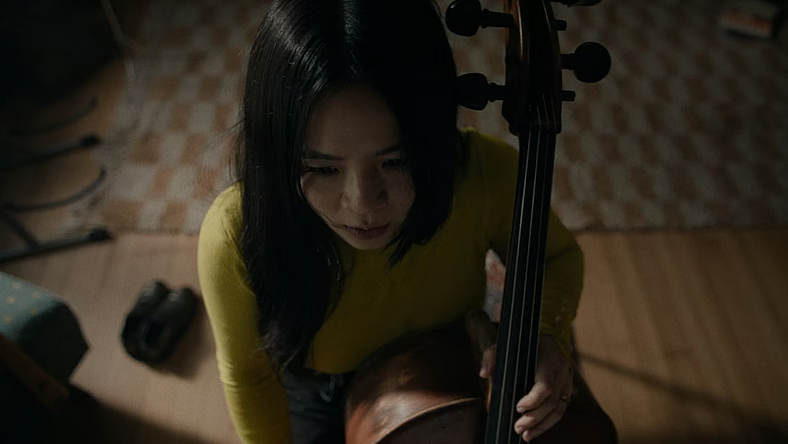
This year’s SXSW featured a fascinating work of historical, supernatural horror. Rock Springs was written by Vera Miao (Two Sentence Horror Stories, Expats) and this is also Miao’s feature film debut as director. The film follows three generations of grieving women as they move to a small town for a fresh start. Soon after, the traumatic past of this place leaks into the present, threatening to expose long buried secrets.
Every once in a while a film comes along that makes you instantly search online to learn more about the events from the film. Rock Springs is one of those films. Broken up into chapters, Miao weaves between the past and the present to tell the story of the Rock Springs Massacre and the lasting impact a horrific event like that can have on the land where it happened. What happened in Rock Springs, WY in 1885 was terrible, yet many viewers like myself probably had never heard of the tragedy until this film. For this part of the film, Miao chose to follow a small group of Chinese men who were bunkmates, working at the mine to send money back to their families in China, when the white miners attacked. In the present, a widowed mother moves her daughter and her mother-in-law to Rock Springs after the death of her husband. While there are some pacing issues throughout the film, primarily due to the chapter format as the story moves from the present to the past and back to the present, it still tells a powerful story. It sheds light on a mostly forgotten act of hatred while also exploring aspects of Chinese traditions. The film also explores the lasting impact of grief and how it is often left to the women to carry that sadness and help spirits cross over. Like the pacing, the tone of the film can be uneven, and many will likely wish they could have seen more scenes from the past rather than having the film focus on the present. Yet it’s impossible to deny the emotional power behind this story.
Adding to the power of Rock Springs are a number of great performances. Kelly Marie Tran (Star Wars: Episode VIII – The Last Jedi, Control Freak) plays Emily, the grieving widow. What makes Tran’s performance so powerful is how she conveys Emily having to be the backbone of the family. She has to hold everything together, find a new job and move her family to a new town, all while caring for her child and her mother-in-law. She isn’t allowed to grieve or show weakness, so she’s forced to hold everything inside unless she gets a private moment alone. It’s a truly heartbreaking performance from Tran that many will be able to relate to. Benedict Wong (Weapons, Doctor Strange) plays Ah Tseng, one of the Chinese miners at Rock Springs. Wong gives one of the most powerful performances of his career, showcasing the close familial bond these men had while working the mines as well as the shock and horror at the unprovoked attack. Other outstanding performances come from Aria Kim in her acting debut, Fiona Fu (Tigertail), and Jimmy O. Yang (Crazy Rich Asians) trading in his typical comedic style for a far more serious role.
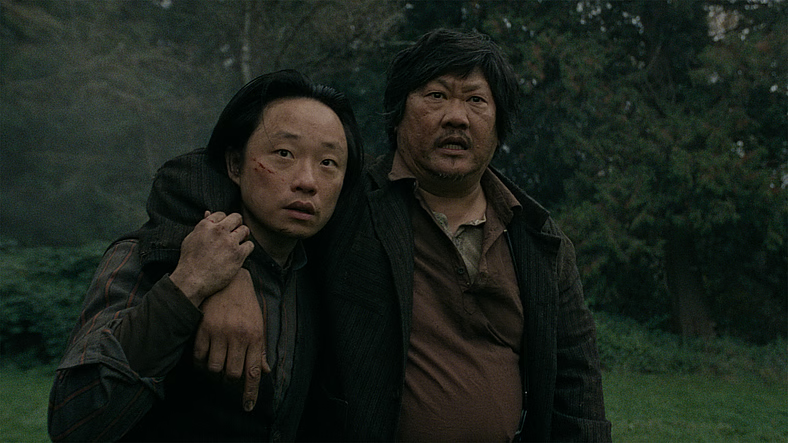
The sights and sounds of Rock Springs are quite interesting. The remote home abutting a lush forest makes for an isolating, unnerving setting for the modern parts of the film. When it comes to the past, the production team built an entire village to recreate the small cabins the miners would have lived in during that time period. Both in the modern and past scenes, the production design team did a great job of incorporating traditional Chinese elements to show the deep connection to culture and tradition. The hair and costume design for the past scenes are also incredibly well done, easily transporting the audience to 1885. One visual element that will likely divide audiences is the creature design for the spirits haunting Rock Springs. It’s a design that certainly makes sense for the context of the plot, and it’s primarily done with practical effects and a touch of CGI, but it can also look a bit goofy at times, taking away from the terror and trauma. There is also some interesting camera work that separates the three chapters based on who the focus of the film is. The first chapter focuses on Kim’s character so the camera work has a still, calm look. For the second chapter focusing on the massacre, there is a lot of handheld camera work to show the movement, fear, and chaos. With the final chapter’s focus on Emily, the camera work shows her anxiety with pinpoint focus and even some split-diopter shots. Tying everything together is a beautiful musical score highlighting the emotions of the film while incorporating more traditional Chinese sounds.
Rock Springs sheds light on a forgotten tragedy through a modern horror lens and traditional Chinese folklore. Considering this is Miao’s first time directing a feature film, she managed to create something very impactful. It has some flaws, such as pacing and interesting choices in visuals, but the stories of trauma and grief are powerful enough to bring tears to the eyes of viewers. Tran and Wong deliver outstanding performances, adding to the emotional depth of the colliding stories being told. Not only will Rock Springs have audiences everywhere doing post-film research on the events the film is based on, but it will also have many keeping an eye out for what Miao does next.
OVERALL RATING: 6.5/10
 The Blogging Banshee