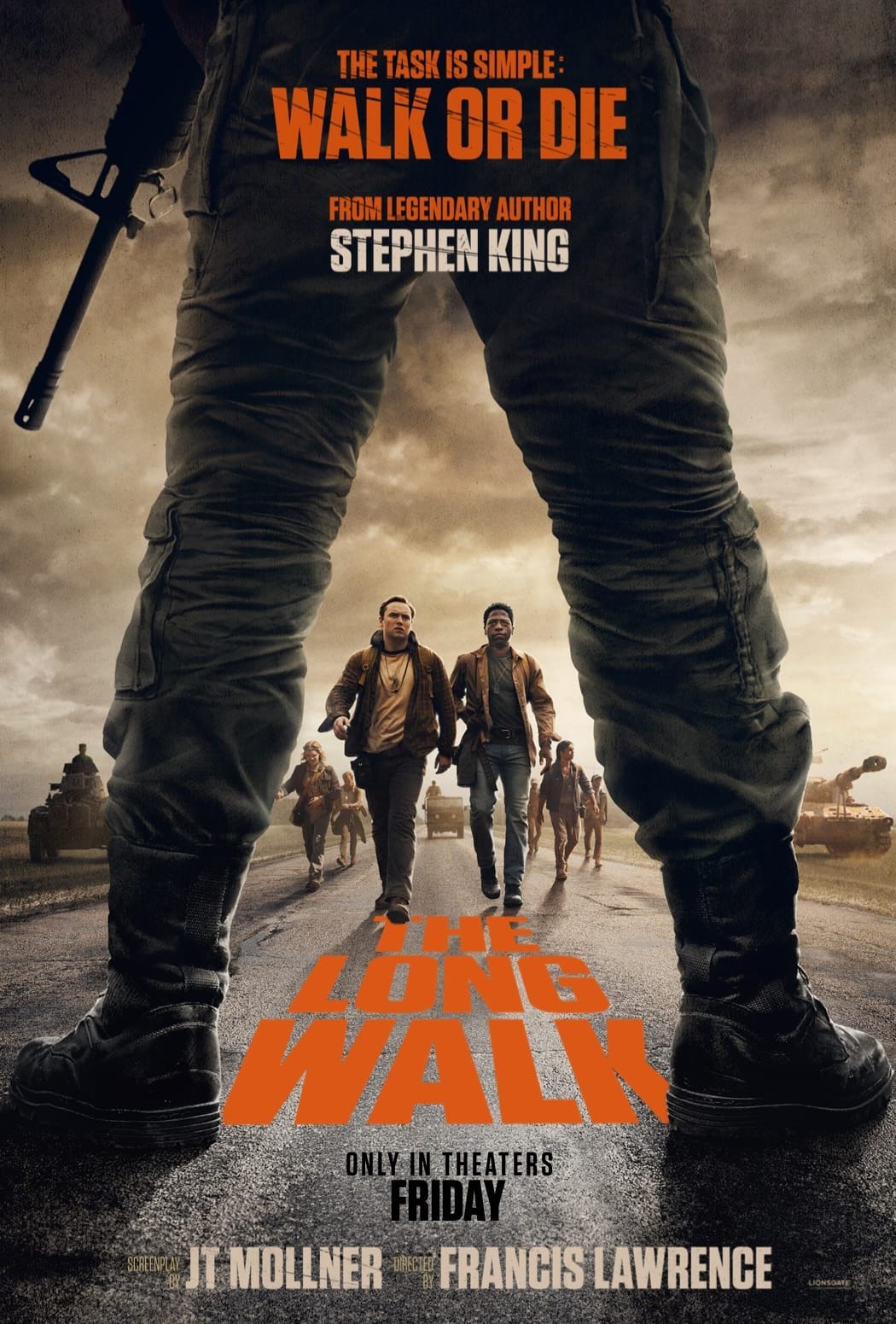
In 1979, under the pseudonym Richard Bachman, Stephen King published a novel titled “The Long Walk.” Almost forty years later, the story has been adapted into a feature length film. Directed by Francis Lawrence (Constantine, The Hunger Games: Catching Fire) with a screenplay by JT Mollner (Strange Darling, Outlaws and Angels), The Long Walk takes place in a near future when the US has become totalitarian and poverty is widespread. Yet each year, one “lucky” young man from each state is chosen to participate in a walk that could be the answer to all their problems, if it doesn’t kill them.
Adapting a Stephen King novel and short story is always a risky task. While there are some truly great adaptations that have been made over the years, there have been even more lackluster or downright bad ones. I’m happy to report The Long Walk is without a doubt one of the great ones. While it’s clear from the beginning this is an alternate version of the United States, or a very near future, many of the details are left vague. The audience knows there was a war that led to financial collapse, and now this annual tradition is one of the only ways the young men can change their lives. Then the young men are introduced, each with their own reason for agreeing to participate in the walk. The rules are simple: they must walk, maintaining a speed of at least 3 mph, until there’s only one left standing. If someone walks too slowly, stops, or tries to flee, they will be shot on sight.
The vague setup allows for the focus of The Long Walk to be on the participants. Most of the story centers on two characters, Ray and Peter, but the audience gets to know many of the young men. Each has their own reason for taking such a risk, and each has different plans if they win, some more altruistic than others. Because this is such a character driven film, it makes it easy to relate to and connect with them. It also makes the inevitable deaths all the more gut-wrenching. Only one can win while all the others die, which makes many of the friendships the participants make along the way even more emotional.
At times the film can feel a bit slow and repetitive, which isn’t surprising considering the audience is watching the characters walk from start to finish, but the filmmakers find ways to keep our attention. Sometimes this is through humor or heartwarming moments, while other times it’s through shock and horror. One thing is for sure, The Long Walk doesn’t shy away from showing the gruesome violence and trauma of this event. These young men have to walk non-stop, without breaks, until only one remains. That means they have to walk while they urinate, try to quickly defecate before they are shot, and they can’t sleep. Sometimes this leads to hilarious antics, but other times it leads to incredibly upsetting moments. This film depicts everything with a raw realism that feels relevant to today’s political climate, leaving audiences disturbed, distressed, and afraid of what our future holds.
The Long Walk wouldn’t be such a success without the truly brilliant cast. Two specific performances carry much of the weight of the film. Cooper Hoffman (Licorice Pizza, Saturday Night) stars as Ray. Ray is the character the audience follows from the beginning, even as his mother drops him off at the starting point of his walk. Hoffman is absolutely perfect as Ray. He is a kind, loyal, and caring person, yet Hoffman also makes it clear Ray harbors trauma, rage, and a pessimism that dictates his every decision. Counter-balancing this character is David Jonsson (Alien: Romulus, Industry) as Peter. Peter is a character with a tragic backstory, living a much more difficult life than most of the other young men. Despite this, he has a light and positivity within him that persists through it all. Jonsson is the heart of this film, exuding love, compassion, and hope in a situation most would find completely hopeless. Hoffman and Jonsson also have truly intoxicating chemistry, seeming as though they’ve been friends for a lifetime rather than just a few days.

The Long Walk takes place in a dystopian version of the United States that could be an alternate reality, or it could be a glimpse into our future. Because of this, the filmmakers wisely kept the landscape relatively barren and avoided showing any technology that could hint at the time period, aside from a few tanks and guns used by the soldiers and a watch the participants wear to monitor their speed. Everything else is mostly generic. The young men wear clothes that were as common thirty years ago as they likely will be another thirty years in the future. As for the locations, the route they walk is almost entirely in the middle of nowhere. The few homes and towns the route passes through are run down, and the people aren’t much better. It’s another hint to the economic collapse that convinces young men to join the long walk.
The Long Walk is a bleak, emotional gut-punch of a film that still finds hope in a dismal world. Together, Lawrence and Mollner have created the best Stephen King adaptation since Doctor Sleep. On paper, the premise doesn’t seem like one that would work as a film, yet these two made it work. Much of the film’s success is likely due to how relevant the story is with the current state of this country. It’s also thanks to the heartfelt, phenomenal performances from both Hoffman and Jonsson. This is a film that will speak to a wide range of audiences, making them laugh, rage, cry, and everything in between. Don’t miss The Long Walk exclusively in theaters beginning Friday, September 12th.
OVERALL RATING: 9/10
 The Blogging Banshee
[…] screen on fire. Audiences will also enjoy the performances from Mark Acheson (Elf), Sharon Bajer (The Long Walk), and David Tomlinson (Fellow […]
LikeLike