
Audiences at Fantasia International Film Festival had the chance to watch what for many is likely their first Kazakh film, Steppenwolf. Written and directed by Adilkhan Yerzhanov (The Owners, Goliaf), the film takes place in a desolate landscape during a time of great violence. In the middle of it all, a woman enlists the help of a psychotic interrogator to help find her missing son, taking the strange duo on a deadly journey.
Audiences are taken on a bleak, violent, nihilistic ride tinged with dark humor. Steppenwolf begins right when the child vanishes. At first, we follow the mother as she seeks help from the police to find her son. Between the scar on her face and her near inability to speak, it’s apparent this woman has experienced great trauma. Eventually she meets a man who agrees to help her, for a price. While he’s clearly also dealing with the traumas of his own past, the man processes this through unflinching violence. An unlikely pair constantly at odds, they cross the wasteland in search of the child and the man who took him.
This is the kind of film that has no real redeemable characters, except perhaps the mother and child. It speaks to the evil that runs rampant, especially the evil carried out by men. What’s more, it makes the audience consider what evil acts are acceptable when they are done for the sake of innocents. It’s a surprisingly thought-provoking plot, especially when considering the film primarily consists of vengeful acts of bloodshed. The film also highlights the way women are treated in times of upheaval. The mother is virtually the only woman in the film, and she is mistreated in some way by virtually every man she encounters throughout the film, even the anti-hero interrogator. Despite all the horrors that occur on screen, there are moments of humor in the interrogator’s inappropriate sense of humor and the mother’s trauma responses to deadly situations.
Every performance in Steppenwolf is a show-stopper. Anna Starchenko (Natari) stars as Tamara, mother of the missing child. Throughout most of the film, Tamara stammers, struggles to speak, and tends to only speak of finding her son. Starchenko is breathtaking in this role, easily conveying Tamara’s distressed mind and love for her child. We don’t know what happened to Tamara in her past, but Starchenko makes it clear she’s a traumatized woman. Berik Aitzhanov (Goliaf, The Liquidator) plays the interrogator, Brajyuk. Brajyuk is a hyper-violent, psychotic brute with a twisted sense of humor. He doesn’t care about the woman or her missing child and only agrees to help for his own personal gain. Yet Aitzhanov slowly reveals the hidden depths to the character, letting the audience know deep down under all that rage and aggression there is at least a sliver of heart. Starchenko and Aitzhanov each give individual performances to remember, but together they show two halves of the same coin, each touched by darkness and dealing with it in their own ways.
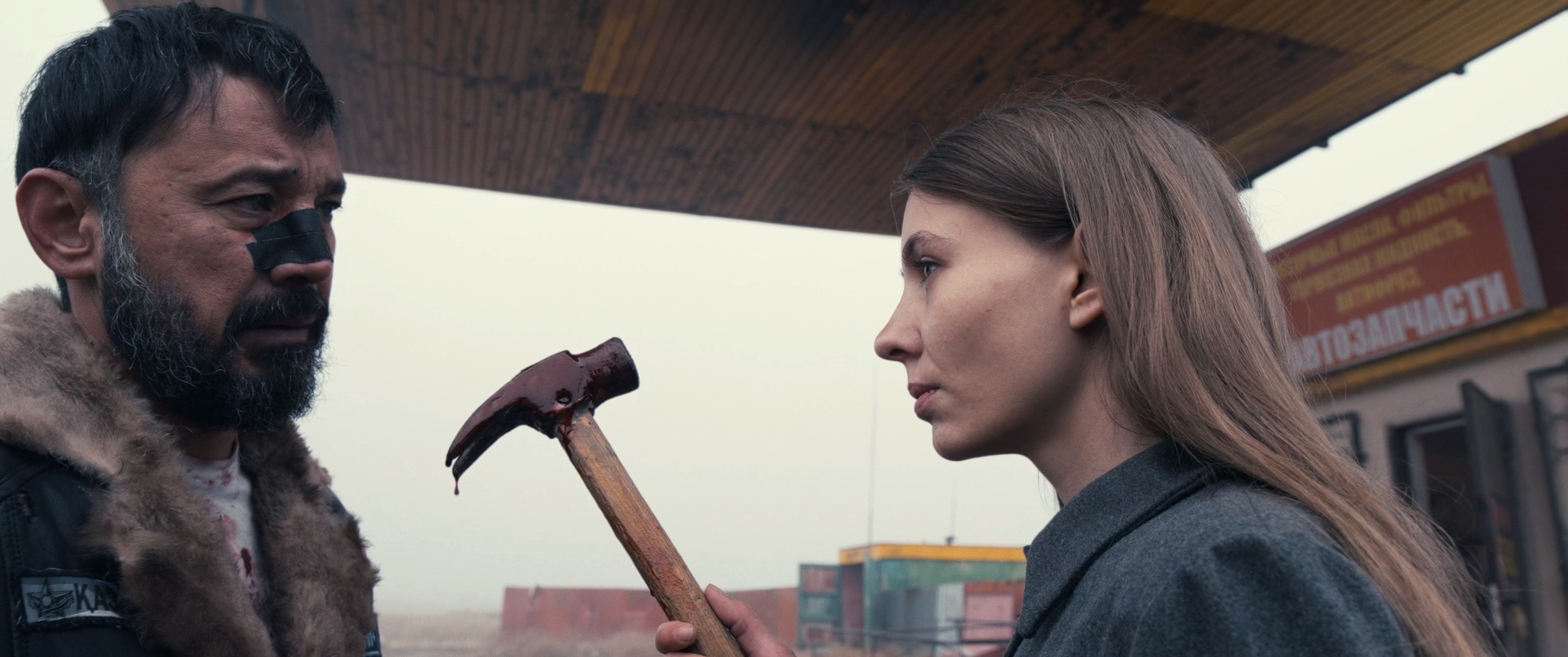
The landscape of Steppenwolf is as stark as the plot. The area is desolate, the buildings are rundown, and everything has a colorless look. It conveys to the audience that this is a hopeless place lacking love or warmth. The only vibrant color comes from the bloody deaths and a pair of red heart sunglasses worn by Tamara and Brajyuk. The coloring, cinematography, costume design, and set design all create a dystopian world that still feels close to reality. Tying the film together is a fantastic 80’s-style synth musical score, adding a bit of lightness and excitement to the bloodshed.
Steppenwolf is a nihilistic, hyper-violent redemption tale filled with social commentary that manages to have a glimmer of hope within the desolation. Yerzhanov crafted a film that tells an important, albeit bleak tale that is still highly entertaining from start to finish. It’s exciting, it’s tense, and it is sure to bring a laugh or two. The performances from both Starchenko and Aitzhanov are phenomenal, bringing to life two unlikely heroes. It can be an uncomfortable watch at times, but Steppenwolf is a memorable and thought-provoking film.
OVERALL RATING: 7.5/10
 The Blogging Banshee