Disclaimer: This piece was written during the 2023 SAG-AFTRA strike. The Blogging Banshee fully supports those on strike and wrote this review in accordance with the SAG-AFTRA guidelines. You can learn more about the strike and how to show your support by clicking the link provided above.
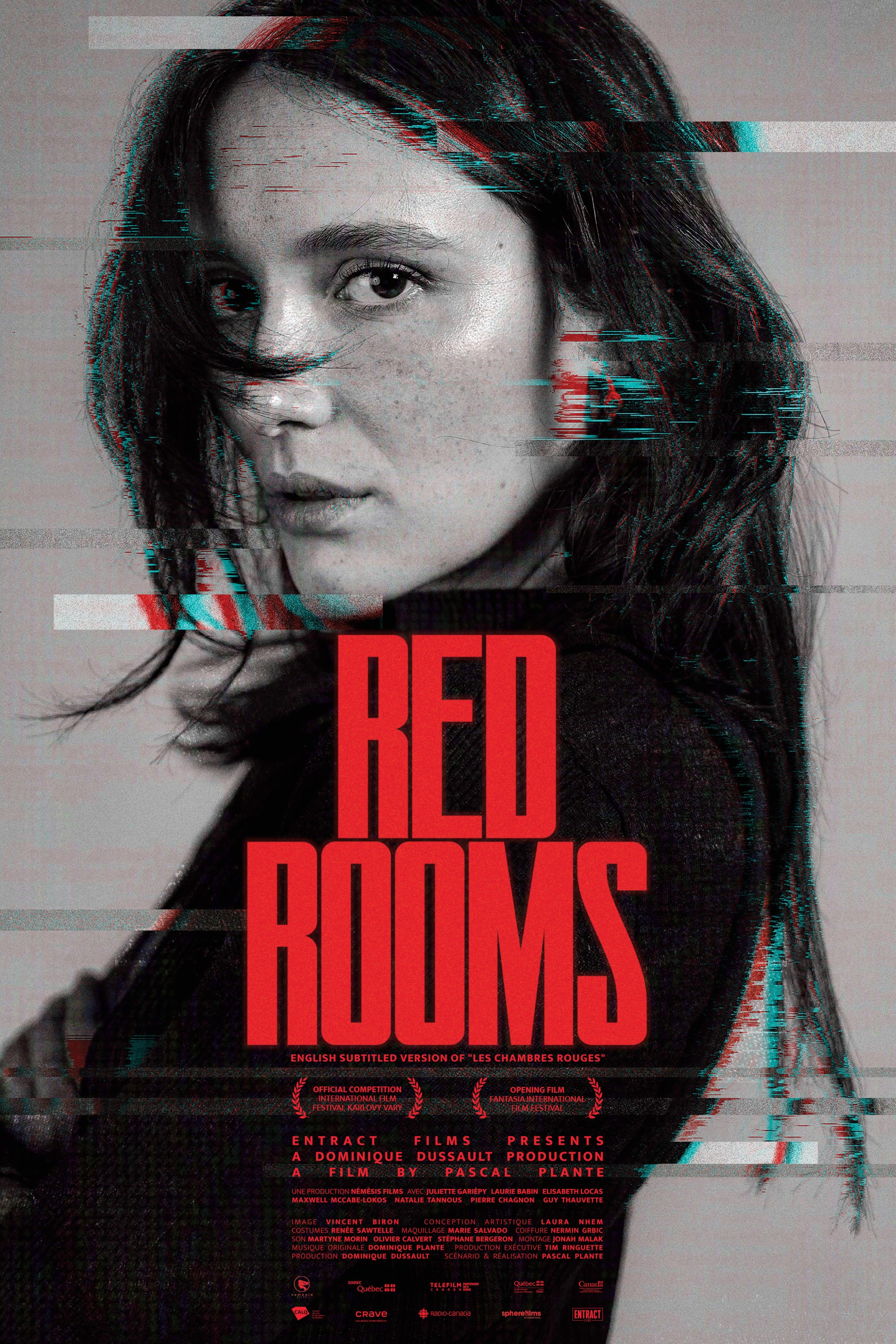
Last week the 2023 Brooklyn Horror Film Festival kicked off. Over the weekend, audiences had a chance to attend a sold out screening of the Canadian psychological thriller, Red Rooms. Written and directed by Pascal Plante (Fake Tattoos, Nadia, Butterfly), the French-language film follows a model named Kelly-Anne as she becomes obsessed with a trial involving the deaths of three teenage girls. As she attends the trial each day, Kelly-Anne befriends another spectator at the trial; but as more shocking details of the case are revealed, it becomes clear these two young women are interested in the trial for very different reasons.
Throughout Red Rooms, Plante creates a dark and twisted tale that is one part courtroom drama, one part suspenseful mystery. All of the information the audience learns about the court case, in the beginning, comes entirely from the courtroom scenes. It allows for the context to be given in a fairly neutral manner, showing the opening arguments from both the prosecution and the defense. The audience doesn’t know why this trial matters to Kelly-Anne, but it’s important enough that she is willing to sleep in a nearby alley to ensure she can get to the courthouse first thing to watch the case unfold. When Kelly-Anne befriends the other spectator, Clementine, it’s immediately clear why this young woman is at the courthouse. Clementine is what many would call a “serial killer groupie.” She is convinced he’s innocent, and may even be in love with, this man she’s never met. The character offers an interesting juxtaposition. Clementine’s intentions are so clear to everyone around her, but Kelly-Anne is shrouded in mystery. As more details of the case come to light, and Kelly-Anne’s stoic façade begins to crack, the tension and mystery only grows. Whatever Kelly-Anne’s goal is, it’s clear she’s willing to risk her reputation, her career, and maybe even her life. Plante’s method of storytelling here is very effective, as it keeps the audience guessing right up until the bitter end, gradually building the suspense for an edge-of-your-seat viewing experience. However, there are some pieces of the puzzle left up to the audience to determine for themselves, which is sure to frustrate some viewers.
What stands out of Red Rooms is how it conveys humanity’s insatiable appetite for watching real tragedy. This is something we are beginning to see more of in horror films. People love to watch true crime shows and read up on the latest high-profile cases involving horrific events. We form our own opinions about guilt and innocence based on the surface-level information we get. Some are so fascinated by these crimes, and those who commit them, that they romanticize serial killers, sometimes not even caring if they are innocent or not. People go to court rooms to watch trials they have nothing to do with, getting a front-row seat to someone else’s misery and heartache. Red Rooms is critical of that while also being sympathetic. Clementine, who initially becomes infatuated with the alleged killer, is certainly naïve and misguided in her affections, but she’s not a bad person. The courtroom scenes often focus on the mother of one of the murdered girls, giving us a glimpse of the agony she is subjected to in the wake of her daughter’s horrific death. Because Kelly-Anne is very detached from emotions, watching these events through her eyes adds to that neutrality established in the opening courtroom scene. She sees all and feels nothing, at least not on the surface, which allows the audience to form their own opinions leading up to the shocking climax.
Red Rooms includes an array of powerful performances. Juliette Gariépy (Boost, You Can Live Forever) stars as Kelly-Anne. There is an outward coldness to Kelly-Anne that adds to the enigma of her intentions, but there is also a warmth. Gariépy shows the audience that warmth in how Kelly-Anne interacts with Clementine, and even in the way she looks at the mother in the courthouse. The audience may never solve the puzzle that is Kelly-Anne, but Gariépy brings this complex character to life in a way that is sure to ensnare audiences. Laurie Babin (Le 422, The Little Girl Who Was Too Fond of Matches) plays Clementine. Babin’s performance in this role is beautiful because Clementine is very different from Kelly-Anne, wearing her heart and emotions on her sleeve. She makes the character someone the audience can empathize with, despite her feelings about the alleged killer. Other great performances come from Elisabeth Locas (Série Noire) as the mother of the youngest victim, giving a heart-wrenching portrayal of the character, and Maxwell McCabe-Lokos (Lars and the Real Girl) as the man on trial, who doesn’t speak and barely even moves throughout the film, but you won’t soon forget his face.

Most of the production design and visuals in this film are quite minimal. The two primary locations are the courtroom and Kelly-Anne’s apartment, both with equally stark appearances, but the courtroom is bright and white, while Kelly-Anne’s apartment is mostly dark. With how heinous the crimes committed in this film are, Plante made the surprising decision to subvert expectations and not show any of it. Instead, the criminal recorded what he did to those three girls and sold the videos on the dark web. The audience hears a small bit of what is captured in the videos, but the only visual is a wash of red across the faces of those watching the videos and their expressions as the horror unfolds. It’s enough to make it clear how atrocious and vile the murders are without any gratuitous on-screen carnage. While gore is a staple of horror films, Plante handles the sensitive subject matter with great care and dignity in keeping with the tone of the film.
Red Rooms is a riveting, layered mystery to intrigue audiences while also forcing them to look inward at why we as humans are so fascinated by the most unspeakable crimes. Plante brings this story to life in a way that is neutral and empathetic, not passing judgement or villainizing any characters until all evidence has been brought to light. By combining elements of a courthouse drama and psychological thriller, Red Rooms allows the performances to be the driving force, rather than leaning into the graphic nature of the murders. Gariépy carries the film on her capable shoulders as she both guides the audience through the case and makes Kelly-Anne a riddle herself. It’s a film that says a lot with very little, leaving a lasting impact on all viewers.
OVERALL RATING: 8.5/10
 The Blogging Banshee